Joel Lagacé
Revealing the Hidden Physics of Free Energy
Revealing the Hidden Physics of Free Energy
A complete educational rewrite that recasts the classic “click-out” diagram and the Bentov-style narrative into a rigorous, step-by-step framework for how consciousness, resonant energy systems, and nonlocal correlations can cooperate. The goal is to explain how a mind-to-field interface might operate, and why an out-of-body vantage amplifies access to information distributed across time.
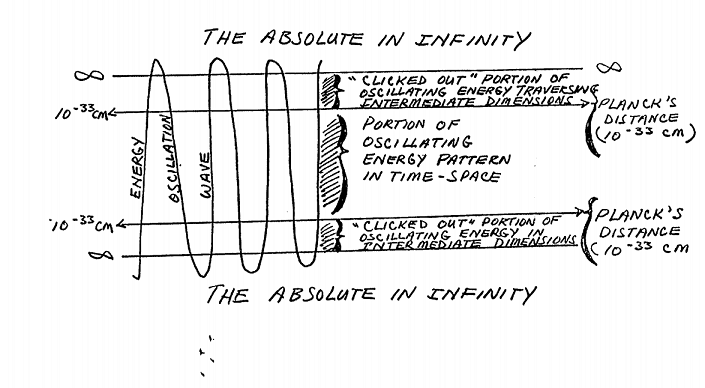
At sufficiently fine scales the familiar, continuous linkage between “what happens” and “what follows” no longer behaves like a smooth film. Motion acquires a staccato character; both time and space exhibit grain. A localized excitation can traverse a patch of space without remaining synchronized to the tick of ordinary time. Pairs of events need not be chained by classical cause and effect; they can be bound by the vacuum’s spontaneous fluctuations. In this regime, “when” and “where” decouple and then re-lock only intermittently.
Within ordinary time-space, distance Δx, duration Δt, and velocity v = Δx/Δt relate in a neat and predictive manner for both particles and waves. Once oscillatory energy ventures into the intermediate layers that bound time-space, its motion is constrained by boundary conditions that are not uniform. Impedance, phase delay, and allowable modes vary from layer to layer. Consequently, the tidy proportionalities that hold in our dimension do not apply; access to past-like and future-like boundary data becomes possible because the traveler is no longer confined to the single “present” slice of the block.
An oscillation with phase φ(t) does not remain entirely in one layer. At specific phase angles satisfying a condition of the form Δφ = 2πn, a portion of the wavefunction tunnels into adjacent layers. In the diagram this is depicted as pieces of the oscillation that vanish from the time-space track and continue through intermediate dimensions. They are not lost; they are displaced into nonlocal channels and can later re-interfere with the slice we observe.
Quantum entanglement supplies the correlation backbone for the clicked-out portions and the portion that remains in ordinary awareness. Entangled subcomponents share a joint state in Hilbert space; when part of the system is phase-advanced into a neighboring layer, correlations persist without a classical signal. The result is information continuity across layers. In the mind-machine context, the task is to hold coherence long enough that the returning, phase-conjugate components can reinforce the originating pattern rather than cancel it.
The machine is thus a dual-loop phase system. The electrical loop sustains a long-lived magnetic standing wave; the neuroelectric loop couples to it. When phase alignment is achieved, portions of the composite pattern step into adjacent layers and re-enter with advanced or retarded phase, delivering time-symmetric reinforcement.
Detaching awareness from the dense somatic channel raises the “starting point” closer to the layers one wishes to contact. Travel time through intervening strata is reduced, so the clicked-out portion interacts longer before re-entry. In practice this means that once awareness has separated from the physical base, the frequency content of consciousness tends to entrain to the new environment, sharpening focus and increasing oscillatory quality factor Q. The deeper the projection, the higher the local gain, and the easier further projection becomes.
Maxwell-classical dynamics are time-symmetric; the “arrow” is imposed by boundary conditions. In the intermediate layers those boundaries are not fixed to a single present. Entangled segments of the oscillation can sample advanced (future-bound) and retarded (past-bound) components and return usable phase information. The mind does not push energy backwards in time; it exploits nonlocal correlation to select trajectories that already satisfy both earlier and later constraints.
The foundation can be stated in one sentence: preserve a high-coherence oscillation, allow fractions of the pattern to step into adjacent layers, and use entanglement-anchored phase return to reinforce the whole. In Tesla-style language, the machine is the brain–resonator composite; energy is drawn from the field by resonance, while information is delivered through nonlocal correlation. The out-of-body vantage simply moves the operating point closer to the interface, increasing the dwell time available for interaction beyond time-space.
I’ve used some of these methods to induce out-of-body–like states, and they’ve genuinely helped my projects—sparking ideas and even “conversations” with figures like Tom Bearden and John Bedini in a kind of timeless, expanded awareness. My first induced experience was intense and unexpected: sleep paralysis set in, I felt wide awake yet unable to move, and a deep hum with strong internal vibrations built rapidly. That transition, I’ve learned, is what happens every time we fall asleep—most of us just aren’t conscious for it. The techniques simply keep awareness online as the body powers down. When the shift completes there’s often a flash; some people even perceive themselves floating out if that’s what they anticipate.
From there it feels like lucid dreaming outside of clock time—free to explore questions, seek information, or “meet” people. The catch is recall. Just like dreams, the details evaporate unless I capture them immediately. I keep a notebook and transfer everything to long-term memory right away; an hour later most of it would be gone. Once I reframed the onset of sleep paralysis as a welcome sign, I began to look forward to it, knowing an OOBE might be near. Using a mix of methods I’ve had varying success, but enough solid results to call it worthwhile—and the insights have meaningfully informed my builds and my sense of how the universe behaves. Anyone can learn this; I’m no monk. With a few practical mechanics, No drugs. You can shortcut into the state surprisingly quickly. I also find much of this applicable to "Universal" frequency laws. Making it also focused to alt energy research.